 Alarm Arcade
Typing challenge alarm: Type to wake up
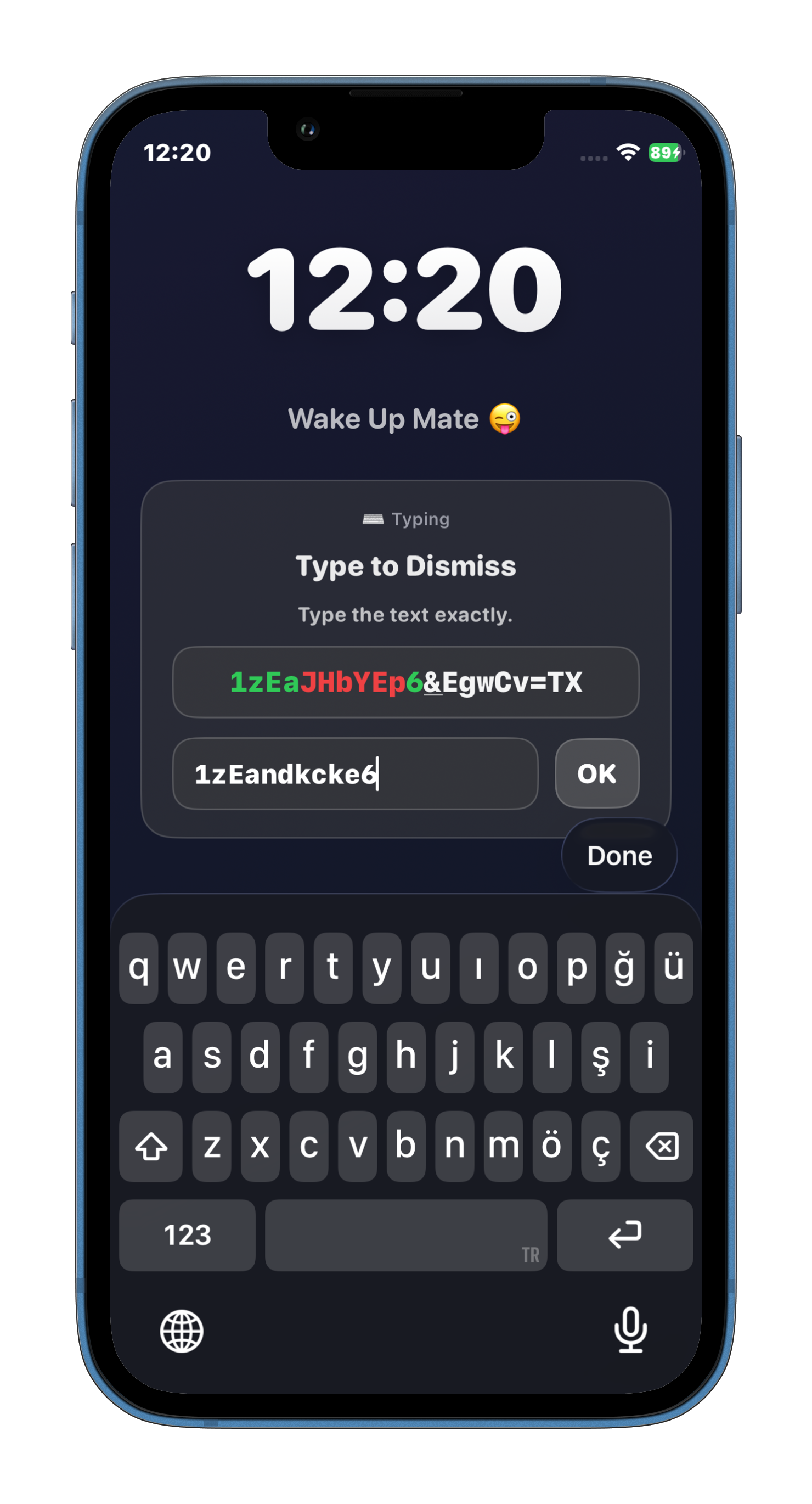
The Typing mission displays a phrase on screen and requires you to type it accurately before the alarm stops. Accurate typing demands language processing, visual attention, and fine motor coordination simultaneously — three systems that your half-asleep brain cannot run in parallel on autopilot.
When the alarm fires, a phrase appears on screen above a keyboard. You type the phrase character by character. Errors may need correction depending on difficulty settings — some levels require exact accuracy, others allow minor mistakes within a tolerance. The phrase changes each alarm. Difficulty scales through phrase length, character complexity, and accuracy requirements. The alarm stops when you've typed the phrase correctly.
Typing is one of the most cognitively demanding alarm missions because it involves three simultaneous systems: language processing (reading and understanding the target phrase), visual feedback processing (watching what you've typed and comparing it to the target), and fine motor sequencing (hitting the correct keys in the correct order). This multi-system demand is exactly what sleep inertia undermines — the ability to coordinate multiple cognitive streams simultaneously. A person who is genuinely half-asleep will make frequent errors, requiring correction and extending the mission. A person who is genuinely awake can complete a moderate phrase in 15–20 seconds.
Who This Is For
- Heavy sleepers who need the highest-demand cognitive challenge available
- People whose jobs or studies involve a lot of reading and writing — familiar but demanding
- Users who've adapted to math alarms and need a completely different cognitive system
- People who type frequently and want their muscle memory challenged, not accommodated
- Anyone building a rotation and needing the strongest cognitive anchor mission
- People who want a mission that takes about 20 seconds when awake and much longer when not
Why Alarm Arcade Works for People using Typing as their wake-up mission
Three cognitive systems at once — the highest demand of any mission
Reading, tracking your own input, and coordinating finger movements are separate cognitive operations. Running all three in parallel is something your brain cannot do reliably during sleep inertia. Typing errors that require correction add correction loops — making the mission self-extending when you're genuinely groggy.
Different phrase every morning — no muscle memory shortcut
Because the phrase changes each alarm, you can't develop a fixed typing sequence that your hands execute automatically. You have to read the phrase, process it, and then type it — every morning. The reading step alone is enough to require conscious language processing.
Natural difficulty calibration — takes longer the groggier you are
A short phrase takes 15–20 seconds when fully awake. The same phrase takes significantly longer when half-asleep — more typos, more corrections, slower finger coordination. The mission length naturally scales with your actual level of wakefulness, which means it always takes long enough to complete the job.
Typing alarm vs standard alarm — Why it actually works
| Feature | Alarm Arcade | Alarmy | iPhone Clock |
|---|---|---|---|
| No subscription required | ✓ | ✗ | ✓ |
| Game-based dismissal | ✓ | ✓ | ✗ |
| Works offline (no account) | ✓ | ✗ | ✓ |
| Pricing | $1.49 one-time | $4.99/mo | Free |
| Multiple mission types | ✓ | ✓ | ✗ |
How to get the most out of the Typing mission
The Typing mission's effectiveness depends on phrase length and accuracy requirements. Easy difficulty uses short, common phrases with lenient accuracy — good for evaluating the mission or for mornings when you need to wake up quickly without frustration. Hard difficulty uses longer phrases with stricter accuracy requirements, meaning frequent corrections and a longer minimum dismissal time.
Typing is recommended as a primary mission for heavy sleepers because it's the hardest to complete on autopilot among Alarm Arcade's ten missions. It requires reading — which means your language processing centers have to be online — before you can even start typing. Use it as the anchor of your rotation: three days on Typing, two days on a physical mission (Shake or Tilt Maze), two days on a different cognitive type (Memory Match or Reaction Grid). This provides strong cognitive enforcement while preventing pure Typing adaptation.
Combine Typing with other missions for maximum effect
Rotation 1 — Strongest cognitive rotation: Typing + Math + Memory Match. Three missions across three distinct cognitive systems: language and motor (Typing), arithmetic and working memory (Math), visual memory and pattern recognition (Memory Match). This is the most cognitively varied three-mission rotation available in Alarm Arcade and the hardest for your brain to build any unified autopilot response to.
Rotation 2 — Cognitive plus physical: Typing + Shake or Tilt Maze. Alternate between the highest-demand cognitive mission (Typing) and a physical mission. This gives your brain days of language-motor challenge and days of physical engagement, preventing adaptation to either category. Rotation 3 — Two-mission weekday cycle: Typing + Simon Says. Both are high cognitive-demand missions without arithmetic. Typing engages language processing; Simon Says engages sequential memory. Neither overlaps with the other, and alternating them within a week ensures your brain never develops a predictable morning cognitive pattern.
Frequently Asked Questions
Phrases vary in length and content. They're designed to be legible when half-asleep but long enough to require sustained attention to type accurately. Longer, more complex phrases appear at higher difficulty levels. The phrase changes each alarm so there's no fixed text to memorize and type by rote.
Behavior varies by difficulty. On more lenient settings, minor typos may be tolerated within an error threshold. On strict settings, errors need to be corrected before the phrase can be submitted. In either case, errors extend the time spent on the mission — which is the intended effect. The more groggy you are, the more errors you make, and the longer the mission takes.
For most people, yes — Typing is slightly harder because it involves more simultaneous cognitive processes. Math requires working memory and arithmetic. Typing requires reading comprehension, visual feedback monitoring, and fine motor sequencing at the same time. That said, difficulty is subjective: people who are fast, experienced typists may find Typing easier than those who type slowly. If Typing feels too easy, combine it with Hard difficulty and a longer phrase, or rotate to Math.
Wake up with your brain switched on
This mission is free to try. Download Alarm Arcade and set it as your alarm tonight.
Download Alarm Arcade — Free